Download The Impending Crisis, 1848-1861
Have you listed exactly what should you get today? Exists any kind of plan and also suggestion to get the brand-new collection of publication? Well, if you have not that type of strategy, we will certainly influence you and also make sure you to take it in provided. Book is much suggested to be always in checklist for you. It is kind of everyday necessity. So, when you reserve much money for various other requirements, you likewise have to set aside some cash to buy the book.
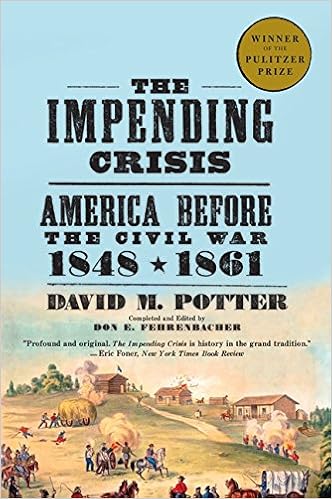
The Impending Crisis, 1848-1861

Download The Impending Crisis, 1848-1861
Discover the strategy of doing something from numerous resources. One of them is this publication entitle The Impending Crisis, 1848-1861 It is an effectively understood publication The Impending Crisis, 1848-1861 that can be recommendation to review currently. This suggested publication is one of the all terrific The Impending Crisis, 1848-1861 collections that remain in this site. You will certainly likewise find various other title as well as styles from numerous writers to browse here.
With this problem, when you need a publication fast, never ever be worried. Just locate and visit this site and get the book quickly. Currently, when the The Impending Crisis, 1848-1861 is just what you seek for now, you can get this book straight in this page. By checking out the link that we offer, you could start to get this publication. It is really simple, you might not need to go offline as well as see the library or publication stores.
What relationship to the analysis book task is from the book, you can see and also understand just how the rule of this life. You will see how the others will stare to others. And also will see just how the literary works is developed for some amusing significance. The Impending Crisis, 1848-1861 is one of the jobs by someone that has such sensation. Based on some realities, it will certainly ensure you to open your mind and also believe with each other regarding this topic. This publication look will help you making much better idea of thinking.
After reading this publication, you will actually understand exactly how specifically the value of reviewing publications as usual. Believe once again as what this The Impending Crisis, 1848-1861 offers you new lesson, the various other books with several themes and genres and million titles will additionally give you very same, or more than it. This is why, we always offer what you require and exactly what you should do. Many collections of guides from not just this country, from abroad a countries worldwide are offered here. By offering simple means in order to help you finding the books, ideally, checking out habit will spread out quickly to other people, as well.
David M. Potter's Pulitzer Prize-winning The Impending Crisis is the definitive history of antebellum America. Potter's sweeping epic masterfully charts the chaotic forces that climaxed with the outbreak of the Civil War: westward expansion, the divisive issue of slavery, the Dred Scott decision, John Brown's uprising, the ascension of Abraham Lincoln, and the drama of Southern secession. Now available in a new edition, The Impending Crisis remains one of the most celebrated works of American historical writing.
Your recently viewed items and featured recommendations
›
View or edit your browsing history
After viewing product detail pages, look here to find an easy way to navigate back to pages you are interested in.
Product details
Paperback: 648 pages
Publisher: Harper Perennial; New edition edition (March 15, 2011)
Language: English
ISBN-10: 9780061319297
ISBN-13: 978-0061319297
ASIN: 0061319295
Product Dimensions:
5.3 x 1.6 x 8 inches
Shipping Weight: 1.9 pounds (View shipping rates and policies)
Average Customer Review:
4.7 out of 5 stars
93 customer reviews
Amazon Best Sellers Rank:
#16,605 in Books (See Top 100 in Books)
In order to understand the crucial years between the Revolutionary War and the Civil War, years in which the character and future course of the American republic were largely created and charted, there are three superb books whose breadth and depth make them required reading: The Rise of American Democracy: Jefferson to Lincoln by Sean Wilentz, Empire of Liberty: A History of the Early Republic, 1789-1815 (Oxford History of the United States) by Gordon S. Wood and The Impending Crisis, America Before the Civil War 1848-1861. The years between the two wars featured immense growth in the size of the new nation, essentially filling the continent and fulfilling manifest destiny. America was now a shining new land bordered by two oceans, an island of spectacular size whose geographic isolation helped it to give birth to a new form of democracy, free from the fear of invasion. The spectacular growth in size functioned as a powerful attraction to landless immigrants. The American form of republican democracy, always a work-in-progress, now contended with an increasingly diverse population whose experience in their new country was like a political laboratory in which the nature of freedom was held up for studyReading all three books offer the reader a firm background in the nature of the events of the era and will provide a true, in-depth understanding of their significance. Where David M. Potter's book really shines is in its tight focus on the critical years of 1848-1861. These were years in which the Mexican War provided America with its southwest. When the dust had cleared and hostilities had ceased, Mexico had lost about one-third of its territory, including nearly all of the present-day states of California, Utah, Nevada, Arizona and New Mexico.The 1857 Dred Scott decision in the Supreme Court held that blacks, whether now enslaved or free, and whose ancestors were imported into the U.S .and were sold as slaves, could not be an American citizen and therefore had no standing to sue in federal court. The ruling essentially said that slaves were not people, but (valuable) property. Abolitionist John Brown resorted to violence in reaction to that ruling and to others. Especially significant was the rise of Abraham Lincoln to the presidency and his willingness to address the slavery issue head-on by issuing the Emancipation Proclamation in 1862.The Impending Crisis, with its keen focus on the final strife-ridden 13 years, is an especially fine introduction to the Civil War. The cascading calamities that led to war are the source of this book's superb narrative. If you are looking for an exceptional analysis of the Civil War's genesis. The Impending Crisis is one of the finest available. If you wish to place these final years in context, then read all three books for a superlative overview of events. The Impending Crisis 1848-1861 is a true classic of historical writing.
Published in 1976, this comprehensive work remains the best book on this era that I have read so far. This is not just my opinion. So said James Lee McDonough in his 2016 biography of William Tecumseh Sherman. "The best single work on the period, for a combination of detailed information, excellent analysis, and acceptable readability remains David Potter's Impending Crisis." (p256, n.15). McDonough both cites and quotes it extensively for good reason. If I was allowed only two books to try to comprehend the American Civil War, I would choose McPherson's Battle Cry of Freedom, and this one. Beware, however that, firstly it is not an easy read, and secondly, once into it, it will be difficult to put down.
I would rate this as one of the most important books I have read. For the first time, I came to an understanding of many of the mysteries of the events that lead to the Civil War which seem impenetrable to a modern reader.Potter first outlines the demographic and social conditions of the United States in the period which preceded the War. The turning point was the Mexican War which upset the balance between North and South with the addition of new territories whose status regarding slavery was unclear. Potter shows that ethnically, the American population in 1850 was quite homogeous---mostly Protestants of English backgroud. Thus, ethnic diversity was NOT the cause of the tensions between North and South. Potter shows that the extreme emotions regarding Kansas and the other new territories regarding the status of slavery in them was purely theoretical...the geographical, climatic and agricultural conditions there were not conducive to a slave economy, yet the South was extremely emotionally involved in this abstract argument.The book then shows how national economic development was retarded by the South in such matters as the building of a Transcontinental Railroad and passage of the Homestead Act, both of which they opposed because they viewed them as strengthening anti-slavery elements in the US.One particularly fascinating thing Potter shows is the fact that anti-slavery sentiment overlapped with anti-immigrant feeling which was espoused by the Know-Nothing nativists. Potter says this seems irrational to a modern person, but he shows how the anti-Catholic feelings aroused by the recent Irish immigration was part and parcel of view of Catholics being part of a supposedly sexually perverted, conspiratorialist organization which they believed the Catholic Church represented, but those who held this felt the same way about the aristocratic slave-owing plantation barons in the South. Thus the new anti-slavery Republican Party went out of its way to attract nativist, anti-Catholic voters.Another interesting fact that is brought out is that many militantly anti-slavery and abolitionist people actually had little love for the Blacks and felt the best solution was to free them and then "send the back where they came from", i.e. Africa. Thus, many anti-slavery people held these views because they thought that slavery was bad for them, by giving slave owners inexpensive labor which free white laborers could not compete with, fearing that it would weaken the free labor movement in the US. Abraham Lincoln came across like this during his famous 1858 Senate race with Stephen Douglas, but Potter attributes this more to political opportunism and trying to win votes among racist Illinois voters than to real sentiments on Lincoln's part.Another valuable section deals with the legal intracicies of the Dred Scott decision. I found out that it did NOT legalize slavery in the states, only Congress was stripped of the power of prohibiting slavery in the territories. It was then believed that states were sovereign and they did have the rigth to prohibit slavery within their borders.Finally, Potter shows that up until Fort Sumter, the North thought the South was bluffing and would not go through with secession.Both the Democratic and Whig parties had both Northern and Southern branches and both had pro- and anti-slavery wings so this political balance held the country together. The collapse of the Whigs and the victory of the anti-slavery, sectional (i.e. Northern only) Republican party in the election of 1860 was the straw that broke the camel's back.I found the book a very good, well-written interesting read, and it provides a real education to the reader regarding social and political developments in a state of national crisis. Highly recommended.
The Impending Crisis, 1848-1861 PDF
The Impending Crisis, 1848-1861 EPub
The Impending Crisis, 1848-1861 Doc
The Impending Crisis, 1848-1861 iBooks
The Impending Crisis, 1848-1861 rtf
The Impending Crisis, 1848-1861 Mobipocket
The Impending Crisis, 1848-1861 Kindle